Why Do So Many Women Feel Responsible for Everyone?
Overwhelm, burnout, caregiver stress, Parenting, aging parents, workplace burn out
Kristen Alzoubi RSW; BSW
5/12/20266 min read

Many women carry an invisible emotional weight that often goes unnoticed by others.
They remember birthdays, notice emotional shifts in the room, anticipate needs before they are spoken, manage schedules, offer emotional support, keep households functioning, and worry about how everyone else is coping—sometimes before checking in with themselves.
Over time, many women begin to feel responsible not only for what they do, but also for how everyone around them feels.
If someone is upset, they try to fix it.
If there is conflict, they feel pressure to calm it.
If someone is struggling, they step in to help.
If things begin falling apart, they often feel they must hold everything together.
Many women become the emotional organizers of their families, relationships, workplaces, and communities without ever consciously choosing that role.
This responsibility can begin very early in life.
Some women grew up in environments where they learned to prioritize the emotions and needs of others in order to maintain peace, avoid conflict, or feel valued. Others were praised for being “the responsible one,” “the helper,” or “the strong one.” Over time, caregiving and emotional labor can become deeply connected to identity and self-worth.
Society also reinforces these expectations. Women are often taught—directly and indirectly—that being nurturing, accommodating, emotionally available, and self-sacrificing are qualities to strive for. While compassion and care are beautiful strengths, constantly placing others first can slowly lead to emotional exhaustion.
Many women become so focused on supporting everyone else that they lose connection with their own needs, emotions, and limits.
They may struggle to:
rest without guilt
say no
ask for help
express anger or frustration
set boundaries
prioritize themselves
recognize when they are emotionally overwhelmed
Eventually, some women begin to feel emotionally depleted while still appearing highly functional on the outside.
They continue caring for others while privately feeling:
exhausted
unseen
emotionally alone
overstimulated
disconnected from themselves
Often, they tell themselves:
“Other people need me more.”
“I should be able to handle this.”
“If I stop, everything will fall apart.”
But constantly carrying responsibility for everyone’s emotions, well-being, and functioning is not sustainable for any one person.
Support, care, and emotional labor were never meant to rest entirely on one individual.
Learning to set boundaries, ask for help, rest, or prioritize your own emotional well-being does not make someone selfish. It allows people to show up in healthier, more connected, and more sustainable ways.
Women deserve support too.
They deserve relationships where care flows both ways. Here at Rooted Rowan we strive to be part of that community you need.
Everyone deserves to exist as full human beings—not only as caregivers, problem-solvers, emotional supports, or the person who “holds everything together.”
Sometimes healing begins when women realize they do not need to earn rest, love, or care through constant self-sacrifice.
You are allowed to matter too.
Small Ways to Care for Yourself While Caring for High-Needs Loved Ones
When someone is caring for children, aging parents, a partner with chronic illness, or a loved one with additional needs, self-care can begin to feel unrealistic or even impossible.
Many caregivers hear advice like:
“Take a vacation.”
“Do more yoga.”
“Make time for yourself.”
While these are great and if you have the time to do them, please do. But when someone is emotionally exhausted, overwhelmed, financially strained, or constantly needed by others, large forms of self-care may not feel accessible.
Sometimes self-care starts much smaller.
Often, it begins with small moments, consistently, that help someone reconnect with themselves as a person—not only as a caregiver.
We have all seen a list of self-care objectives, but the trick is taking the time to notice yourself and in what areas you are most depleted. What can you do to get the most bang for your buck? Maybe you are already outside with your kids all day and it would be more beneficial for you to have time alone? Only you are able to evaluate yourself in this way but through active communication you can express your needs to others when you are drowning as well. There are people and resources that do want to help you just have to be able to know yourself well enough to ask for what you want most.
Here are gentle, realistic ways caregivers can support themselves even during overwhelming seasons of life:
Brushing your teeth even when you feel emotionally depleted
Drinking water before your coffee
Sitting in silence for 5 minutes before responding to everyone’s needs
Letting yourself cry without judging yourself
Taking slow deep breaths while in the bathroom or shower
Stepping outside for fresh air, even briefly
Feeling the sun on your skin
Listening to music that comforts you
Asking someone to help with one task instead of trying to manage everything alone
Eating something nourishing instead of skipping meals or eating your kids leftovers
Wearing comfortable clothes that help your body relax
Letting a text or phone call wait until later
Saying “I can’t do that today”
Resting without needing to “earn” it first
Accepting help without apologizing
Taking a shower without rushing
Watching a comforting show before bed
Allowing yourself moments that are not productive
Talking honestly with someone safe about how hard things feel
Going to medical appointments for your own health needs
Taking medications consistently if you have your own health concerns
Leaving dishes or laundry for later when your body and mind need rest
Sitting in your car for a few extra quiet minutes before going inside
Remembering that survival seasons require gentleness, not perfection
For many caregivers, self-care is not about luxury. It is about preventing complete emotional depletion.
Many caregivers, parents, and people supporting high-needs loved ones experience an incredible amount of loneliness that often goes unseen by others. Even when surrounded by people, they may still feel emotionally isolated, overstimulated, or as though there is no one truly helping carry the weight with them.
Over time, constantly being needed by others without receiving adequate support yourself can begin to impact not only emotional well-being, but also physical health, relationships, identity, and overall quality of life. Humans were never meant to carry overwhelming responsibilities entirely alone.
Creating a “village” does not mean someone is failing. It means recognizing that support, care, rest, and connection are essential parts of sustainable caregiving and emotional wellness.
A village can look different for everyone. Sometimes it includes family, friends, neighbours, faith communities, support groups, therapists, respite workers, home care, medical professionals, or trusted community supports. Often, healing begins when people stop trying to do everything alone and allow others to step in beside them.
Having a supportive team can create small but meaningful moments of space—space to rest, shower, attend appointments, sleep, reconnect with yourself, spend time outdoors, nourish your body, process emotions, or simply breathe without constantly anticipating someone else’s needs.
These moments are not selfish. They are necessary.
Why do you over give in relationships? read this blog: https://rootedrowan.com/why-you-keep-overgiving-in-relationships-and-why-it-feels-so-hard-to-stop
When people receive support themselves, they are often better able to care for others in ways that feel more emotionally connected and sustainable long-term. Relationships may begin to feel less focused on constant survival and more focused on connection, presence, and shared moments again.
Your body, mind, and soul deserve care too.
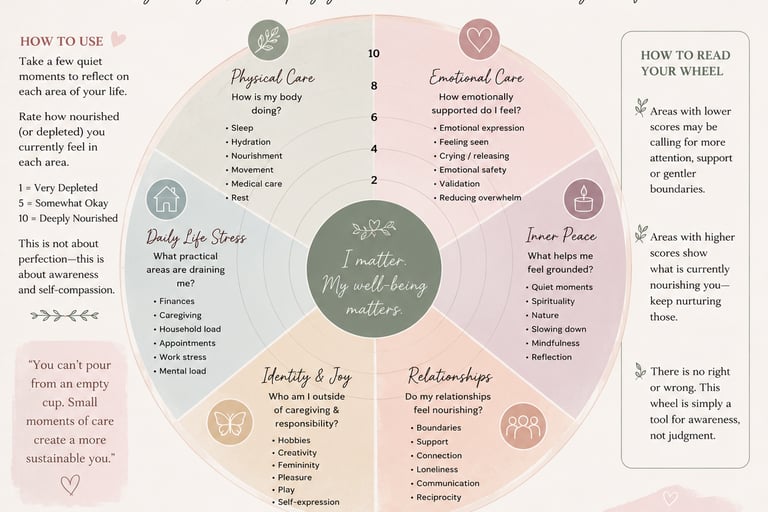
Self-Care Wheel (sometimes also connected to the “Wheel of Wellness” or “Wheel of Life” concepts). Is one tool you can use to help identify areas of depletion.
The version most therapists and helping professionals use today was popularized by Olga Phoenix and was inspired by trauma and wellness work from Karen Saakvitne and Laurie Pearlman in Transforming the Pain: A Workbook on Vicarious Traumatization (1996).
The idea behind it:
people become depleted in different areas of life
burnout is rarely just “physical tiredness”
visually mapping depletion helps people identify where support is missing.
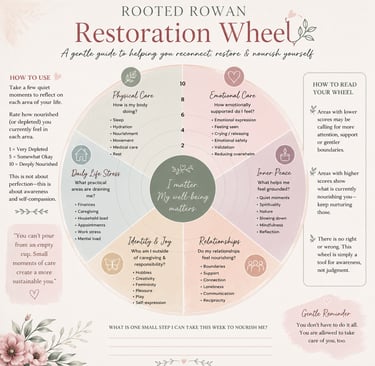
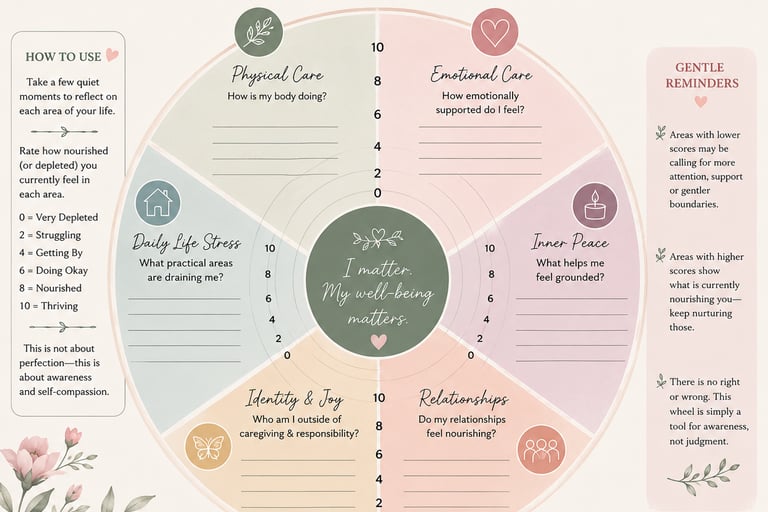
At Rooted Rowan Counselling, I often explore self-care as something much deeper than occasional breaks or “treat yourself” moments. Inspired by holistic wellness frameworks such as the Self-Care Wheel developed by Olga Phoenix and trauma-informed wellness approaches, the Restoration Wheel was created as a gentle way to help individuals identify where they may be emotionally, physically, and mentally depleted.
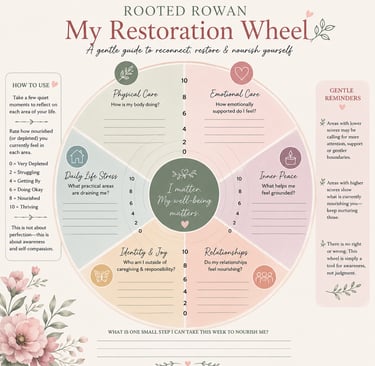
Feel free to use the wheels below for reference. You can just monitor it visually if you are limited in time, but if you are able, you can also recreate your own wheel and write inside the areas that will serve you most.
When caregivers receive support themselves, they are often able to feel more emotionally present, less overwhelmed, and more connected in their relationships. Caring for yourself is not abandoning others. It helps create a more sustainable way of caring long-term.
You do not have to disappear in order to support the people you love.
Even small moments of care matter.
—
Rooted Rowan Counselling
Supporting women experiencing emotional overwhelm, caregiver stress, burnout, relationship strain, and life transitions with compassion and care.