Cognitive Behavioural Therapy (CBT): How Changing Your Thoughts Can Change Your Life
CBT, depression, anxiety
7/8/202611 min read


Have you ever noticed that two people can experience the exact same situation but walk away feeling completely different?
Imagine two coworkers receive the same email from their manager asking to meet tomorrow morning.
One thinks, "I wonder what this is about." They continue with their day.
The other immediately thinks, "I'm in trouble. I'm getting fired. I must have done something wrong." Their heart races, they can't concentrate, and they spend the rest of the day worrying.
The situation is identical.
The difference lies in the meaning each person gives it.
This is one of the foundational ideas behind Cognitive Behavioural Therapy (CBT)—our thoughts influence our emotions and behaviours. While we can't control everything that happens to us, we can learn to recognize and challenge the thinking patterns that contribute to anxiety, depression, stress, and low self-esteem.
CBT is one of the most well-researched, well known and effective forms of psychotherapy and has helped millions of people better understand themselves and improve their mental health. It is great for anxiety, depression, relationship issues but it can be useful in a multitude of situations. It is also a great therapy ideology because it is one you can practice on your own without having to pay a counselor for help.
What Is Cognitive Behavioural Therapy?
Cognitive Behavioural Therapy (CBT) is based on a simple but powerful concept:
Our thoughts, emotions, behaviours, and physical sensations are all connected.
When one part of the cycle changes, the others often change as well.
For example:
Situation
You text a friend and they don't reply.
↓
Thought
"They must be upset with me."
↓
Emotion
Anxiety.
↓
Physical Response
Tight chest, racing heart, upset stomach.
↓
Behaviour
You apologize repeatedly or avoid reaching out again.
The behaviour may temporarily reduce your anxiety, but it also reinforces the belief that you did something wrong.
CBT helps interrupt this cycle.
Instead of automatically accepting every thought as true, you learn to become curious about your thinking.
Thoughts Are Not Facts
One of the most freeing lessons in CBT is realizing that just because you think something doesn't mean it's true.
Our brains are constantly interpreting the world around us.
Sometimes those interpretations are accurate.
Sometimes they're influenced by:
previous experiences
anxiety
trauma
low self-esteem
depression
perfectionism
fear of rejection
stress
If you've ever caught yourself thinking:
"Everyone is judging me."
"I'm going to fail."
"I'm a terrible parent."
"Nothing ever works out."
"I'm not good enough."
…you've experienced automatic thoughts.
Automatic thoughts happen quickly and often feel believable.
CBT teaches us to pause before accepting them as truth.
Instead of asking,
"Is this thought true?"
we begin asking,
"Is there evidence for this thought? Is there evidence against it?"
Common Thinking Traps
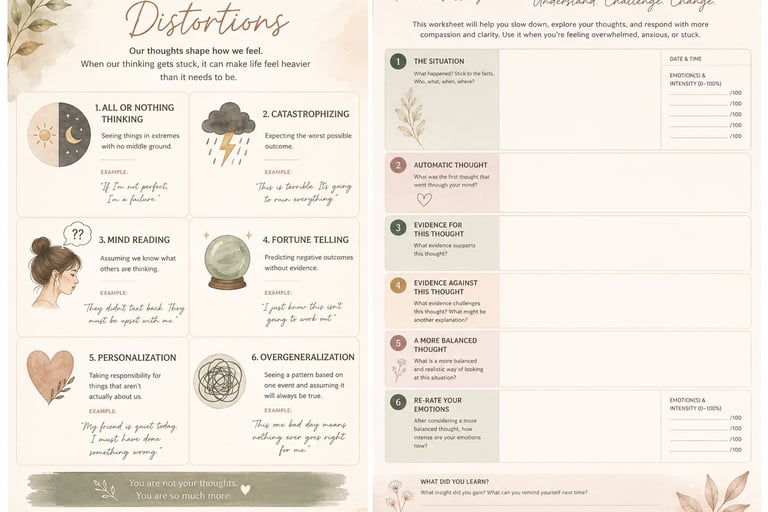
Our brains naturally rely on shortcuts to process information quickly. Sometimes those shortcuts become distorted thinking patterns, also called cognitive distortions.
Here are a few common examples:
Common Cognitive Distortions (Thinking Traps)
Our brains are constantly interpreting the world around us. Sometimes those interpretations are accurate, but sometimes our minds rely on shortcuts that lead us to inaccurate conclusions. These patterns are called cognitive distortions or thinking traps.
The good news? Once you recognize these patterns, you can begin to challenge them.
1. All-or-Nothing Thinking
Seeing situations in extremes with no middle ground.
Example:
"If I make one mistake, I'm a complete failure."
Balanced Thought:
"Everyone makes mistakes. One mistake doesn't erase all of the things I've done well."
2. Catastrophizing
Automatically imagining the worst possible outcome.
Example:
"If I embarrass myself during this presentation, everyone will think I'm incompetent."
Balanced Thought:
"Even if I stumble, most people probably won't remember it, and one presentation won't define my abilities."
3. Mind Reading
Assuming you know what someone else is thinking without evidence.
Example:
"She didn't smile at me. She must not like me."
Balanced Thought:
"I don't know why she didn't smile. There could be many explanations."
4. Fortune Telling
Predicting the future as though it's already decided.
Example:
"There's no point applying—I won't get the job."
Balanced Thought:
"I can't predict the outcome. The only way to know is to try."
5. Personalization
Taking responsibility for things that aren't actually your responsibility.
Example:
"My friend seems quiet today. I must have done something wrong."
Balanced Thought:
"There are many reasons someone might seem quiet, and not all of them have anything to do with me."
6. Overgeneralization
Taking one negative event and assuming it represents every future situation.
Example:
"That relationship ended. I'll always be alone."
Balanced Thought:
"One relationship ending doesn't determine what my future relationships will look like."
7. Emotional Reasoning
Believing something is true simply because it feels true.
Example:
"I feel like a failure, so I must be one."
Balanced Thought:
"Feelings are important, but they aren't always facts. My emotions are giving me information, not necessarily the whole truth."
8. Should Statements
Holding yourself or others to rigid, unrealistic expectations.
Example:
"I should always have everything under control."
"I shouldn't need help."
Balanced Thought:
"It's okay to struggle sometimes. Being human means I won't always have everything figured out."
9. Labeling
Reducing yourself or someone else to a single negative label.
Example:
"I forgot that appointment. I'm so stupid."
Balanced Thought:
"I forgot something today. That doesn't define who I am."
10. Mental Filtering
Focusing exclusively on the negative while ignoring the positive.
Example:
You receive ten compliments and one criticism, but spend the entire day thinking about the criticism.
Balanced Thought:
"Both positive and negative feedback are part of the bigger picture."
11. Discounting the Positive
Rejecting compliments, successes, or achievements.
Example:
"They only complimented me because they were being nice."
"Anyone could have done what I did."
Balanced Thought:
"Maybe I actually earned that compliment."
12. Magnification and Minimization
Blowing mistakes out of proportion while minimizing strengths.
Example:
"That typo ruined everything."
Meanwhile, overlooking hours of excellent work.
Balanced Thought:
"One mistake doesn't erase all of the effort I put in."
13. Jumping to Conclusions
Drawing conclusions before having enough information.
This often includes:
Mind Reading
Fortune Telling
Example:
"They haven't texted back. They must be upset with me."
Balanced Thought:
"I don't have enough information to know why they haven't replied."
14. Control Fallacies
Believing you have complete control over everything—or no control over anything.
External Control
"Everything bad happens because of other people."
Internal Control
"Everything is my fault."
Balanced Thought:
"Some things are within my control, and some things aren't. I can only be responsible for my own actions."
15. Comparison Thinking
Constantly comparing yourself to others while assuming they are doing better than you.
Example:
"Everyone else has their life together except me."
Balanced Thought:
"I'm comparing my behind-the-scenes to someone else's highlight reel."
16. Perfectionism
Believing your worth depends on flawless performance.
Example:
"If I can't do it perfectly, I shouldn't do it at all."
Balanced Thought:
"Progress is more important than perfection."
17. Black-and-White Identity Thinking
Defining your entire identity based on one experience.
Example:
"I failed this exam, so I'm not smart."
Balanced Thought:
"One performance doesn't define who I am or what I'm capable of."
18. Projection
Assuming that other people feel, think, or intend what you are feeling or believing, often without evidence. Sometimes we unknowingly project our own fears, insecurities, or emotions onto others.
Example:
"I feel embarrassed about what I said, so everyone else must think I sounded stupid too."
Or:
"I'm worried I'm not doing enough as a parent, so when another parent gives me advice, I assume they're judging me."
Balanced Thought:
"Just because I'm thinking or feeling something doesn't mean other people are. I can't know what someone else is thinking unless they tell me."
Questions to Ask Yourself:
Am I assuming someone else feels the same way I do?
What evidence do I have that this is true?
Could my own fears or insecurities be influencing how I'm interpreting this situation?
Have I asked for clarification, or am I filling in the blanks?
Remember...
Everyone experiences cognitive distortions from time to time. They are a normal part of how the human brain processes information—especially when we're stressed, anxious, overwhelmed, or emotionally activated.
The goal of CBT isn't to eliminate these thoughts completely. Instead, it's to become aware of them so they no longer run on autopilot. When you can recognize a thinking trap, pause, and ask yourself whether there might be another way of viewing the situation, you create space for more balanced thinking, healthier emotions, and intentional choices.
Your first thought is often automatic. Your second thought is where growth begins.
CBT Doesn't Ask You to "Think Positive"
This is one of the biggest misconceptions about CBT.
CBT isn't about pretending everything is wonderful.
It's not about replacing every negative thought with an unrealistically positive one.
Instead, CBT helps you develop balanced thinking.
For example:
Instead of
"I'm going to fail."
Try
"This is challenging, but I've handled difficult situations before."
Instead of
"Nobody likes me."
Try
"I'm feeling lonely today, but I don't actually know what other people are thinking."
Balanced thoughts are more believable, and because they're believable, they're more effective.
How Behaviour Affects Our Mental Health
CBT isn't just about changing thoughts.
It also recognizes that our behaviours can either strengthen or weaken anxiety and depression.
For example:
When we're anxious, we often avoid situations that make us uncomfortable.
Avoidance provides temporary relief.
But over time, it teaches the brain:
"That situation really must have been dangerous."
Similarly, depression often causes people to withdraw from activities they once enjoyed.
Unfortunately, withdrawing often leads to even less motivation and lower mood and avoidance can often enhance anxiety.
CBT encourages small, manageable actions that help break these cycles.
Sometimes changing behaviour comes before feeling better.
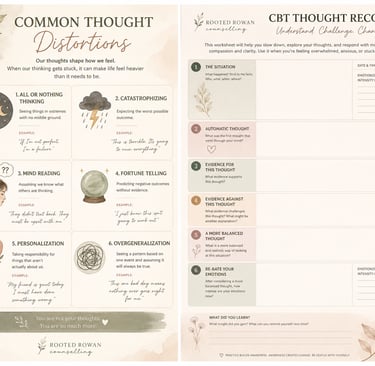
A Practical CBT Exercise: Learning to Challenge Your Thoughts
The next time you find yourself feeling anxious, overwhelmed, sad, or frustrated, try slowing down and working through this exercise. You may be surprised to discover that your emotions are being influenced not only by what happened, but by the meaning your mind assigned to the situation.
Remember, the goal isn't to convince yourself that everything is fine. The goal is to examine your thoughts with curiosity rather than automatically accepting them as facts.
Step 1: Identify the Situation
Start by describing what happened using only the observable facts.
Imagine you're a reporter describing the event. Avoid including your interpretations or assumptions.
For example:
❌ "My boss hates me."
This isn't a fact—it's a conclusion.
Instead write:
✅ "My boss walked past me this morning without saying hello."
Or:
✅ "My friend hasn't responded to my text in two days."
Separating the facts from your interpretation helps you see where your thoughts begin to influence your emotions.
Step 2: Identify Your Automatic Thought
Next, ask yourself:
"What was the very first thought that popped into my mind?"
Automatic thoughts happen quickly. Often, we don't even notice them because they occur in the background.
Write the thought exactly as it appeared, even if it seems irrational or embarrassing.
Examples might include:
"I must have done something wrong."
"They're mad at me."
"I'm going to fail."
"Nobody likes me."
"I'm not good enough."
Don't judge the thought or try to change it yet. Simply become aware of it. Awareness is the first step toward change.
Step 3: Identify Your Emotion
Now ask yourself:
"What emotion did this thought create?"
Try to be as specific as possible.
Instead of simply writing "bad" or "upset," identify the emotion more precisely.
Examples include:
Anxiety
Fear
Sadness
Shame
Embarrassment
Guilt
Anger
Loneliness
Disappointment
Frustration
Next, rate how intense the emotion feels on a scale from 0 to 100, where:
0 = You aren't experiencing the emotion at all.
50 = The emotion is noticeable but manageable.
100 = The emotion feels overwhelming.
For example:
Emotion: Anxiety
Intensity: 85/100
Giving your emotion a number allows you to compare it later and see whether challenging your thoughts changes how strongly you feel.
Step 4: Examine the Evidence
Now comes the heart of CBT.
Rather than asking, "Is my thought true?" ask, "What evidence do I actually have?"
Imagine you're a detective gathering information. Your goal isn't to prove yourself right or wrong—it's to understand the whole picture.
Ask yourself:
What evidence supports this thought?
What evidence challenges this thought?
Am I assuming I know what someone else is thinking?
Am I predicting the future without evidence?
Am I overlooking information that doesn't fit my fear?
Could there be another explanation?
If my best friend told me this story, what would I say to them?
For example:
Situation: My friend hasn't replied to my text.
Automatic Thought: "They're upset with me."
Evidence Supporting the Thought:
They usually reply quickly.
They haven't answered today.
Evidence Against the Thought:
They mentioned they had a busy week.
They've forgotten to reply before.
Nothing happened during our last conversation that suggested they were upset.
I don't actually know why they haven't responded.
Notice how examining the evidence doesn't force you to ignore your concerns. Instead, it helps you move from assumptions to possibilities.
Step 5: Create a More Balanced Thought
Now ask yourself:
"Based on all of the evidence, what would be a more balanced way of looking at this?"
A balanced thought isn't blindly optimistic, nor is it overly negative. It simply reflects the facts as accurately as possible.
For example:
Instead of:
"They're ignoring me because they don't like me anymore."
You might say:
"I don't know why they haven't replied yet. There are several possible explanations, and I don't have enough information to assume the worst."
Notice how this doesn't dismiss your feelings—it simply makes room for uncertainty instead of fear.
Finally, return to your emotion and rate it again.
Perhaps your anxiety has decreased from 85/100 to 45/100. The goal isn't necessarily to make difficult emotions disappear. It's to reduce their intensity enough that you can respond thoughtfully rather than react automatically.
Like any new skill, CBT takes practice. Your brain has spent years developing certain thinking habits, so it makes sense that they won't change overnight. But each time you pause, question your assumptions, and consider a more balanced perspective, you're strengthening new neural pathways and teaching your brain that it doesn't always have to jump to the worst-case scenario.
Please feel free to use my workbook page; a sneak peek from my upcoming book
When Thoughts Feel Impossible to Change
Sometimes people become frustrated because they know their thoughts aren't logical—but they still feel true. sometimes it takes another person to help you examine these thoughts differently and speak to someone with different life experiences. Sometimes it is hard to examine your thought or discover your automatic thoughts by yourself.
That's because thoughts don't exist in isolation.
Our nervous system, attachment experiences, trauma history, and relationships all influence how we interpret the world.
If you've spent years believing you aren't good enough, simply repeating positive affirmations probably won't change that belief overnight.
This is why CBT is often even more effective when combined with approaches that address emotions, relationships, and the nervous system.
Understanding why your brain developed certain beliefs can make challenging them feel more compassionate and achievable.
When Counselling Can Help
Sometimes we become so accustomed to our thinking patterns that we don't even recognize them anymore.
A therapist can help you identify unhelpful beliefs, understand where they came from, and develop healthier ways of responding to life's challenges.
Together, you can learn to:
recognize thinking traps
reduce anxiety and worry
improve self-esteem
manage depression
develop healthier coping strategies
build emotional resilience
respond to stress with greater confidence
CBT isn't about becoming a different person.
It's about learning to respond to yourself with greater awareness, flexibility, and self-compassion.
Final Thoughts
Our thoughts have incredible power.
They shape how we interpret situations, how we feel about ourselves, and the choices we make each day.
The good news is that thoughts are not set in stone.
Like any habit, thinking patterns can change with practice.
You don't have to believe every thought your mind offers.
Sometimes the most healing question you can ask yourself is:
"Is there another way of looking at this?"
That single moment of curiosity can open the door to new perspectives, healthier emotions, and more intentional choices.
How Rooted Rowan Counselling Can Help
At Rooted Rowan Counselling, I use Cognitive Behavioural Therapy alongside other evidence-based approaches to help women better understand the connection between their thoughts, emotions, behaviours, relationships, and nervous system. Together, we'll explore the patterns that may be keeping you stuck and develop practical, personalized strategies to help you move toward greater confidence, emotional balance, and self-compassion.
You don't have to silence every negative thought to experience healing. Sometimes, healing begins by learning to respond to those thoughts differently—and discovering that you are capable of more than your inner critic has led you to believe.